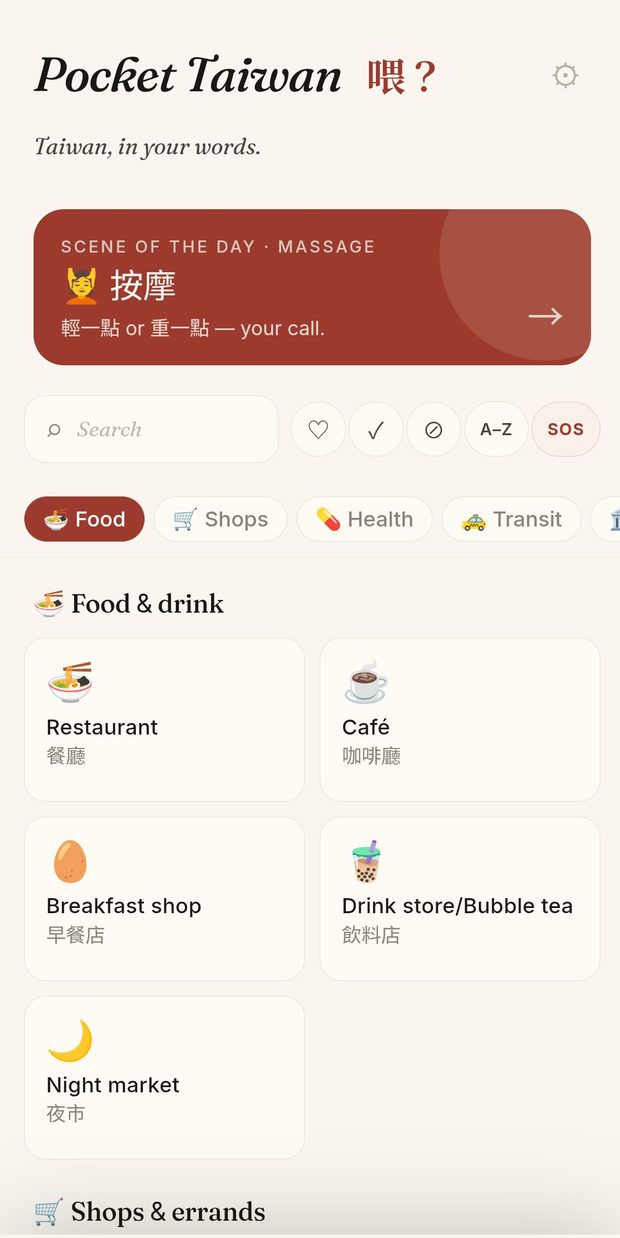
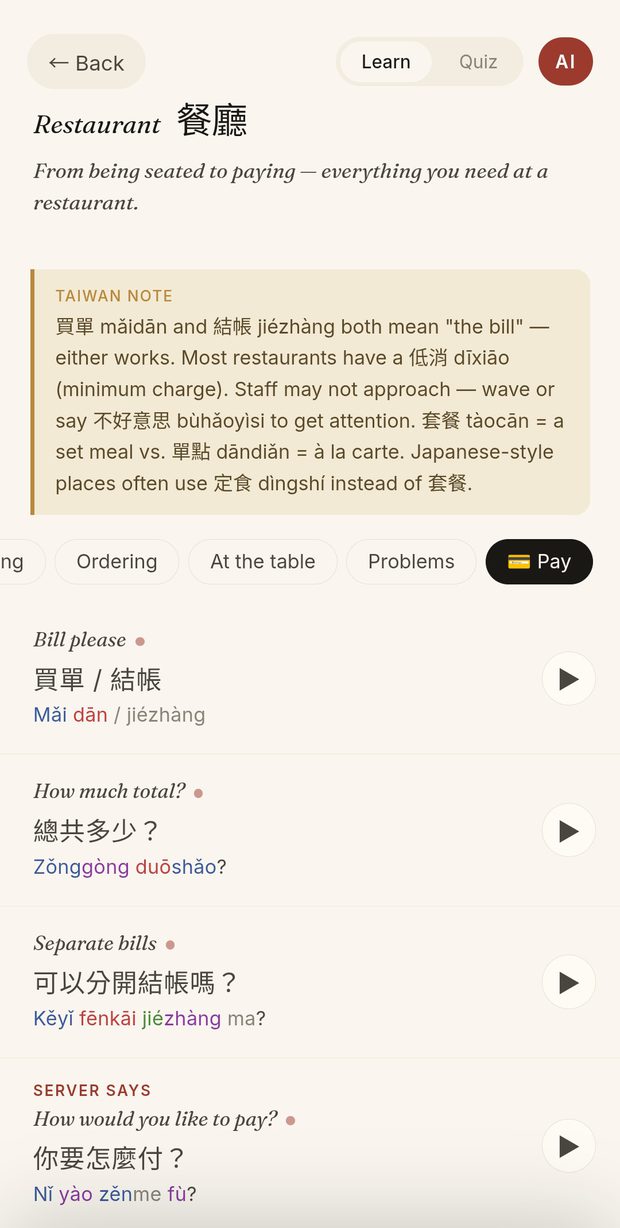
You can order bubble tea without thinking, yet walk into a bank to set up a credit card and realize you know zero Chinese for that situation. Pocket Taiwan is organized by situation, giving you the phrases you'll need and the replies you'll hear, in Traditional characters with Taiwan-accurate pinyin and audio.
New · freePocket Taiwan World. Walk into Raohe Night Market and order in Mandarin — in your browser, on a phone or a computer.→One email the day it's out.
Five situations free · one-time unlock for the rest · no subscription, no account, no ads
Pinyin is colored by tone, so your eye learns the shape of a word before your ear does.
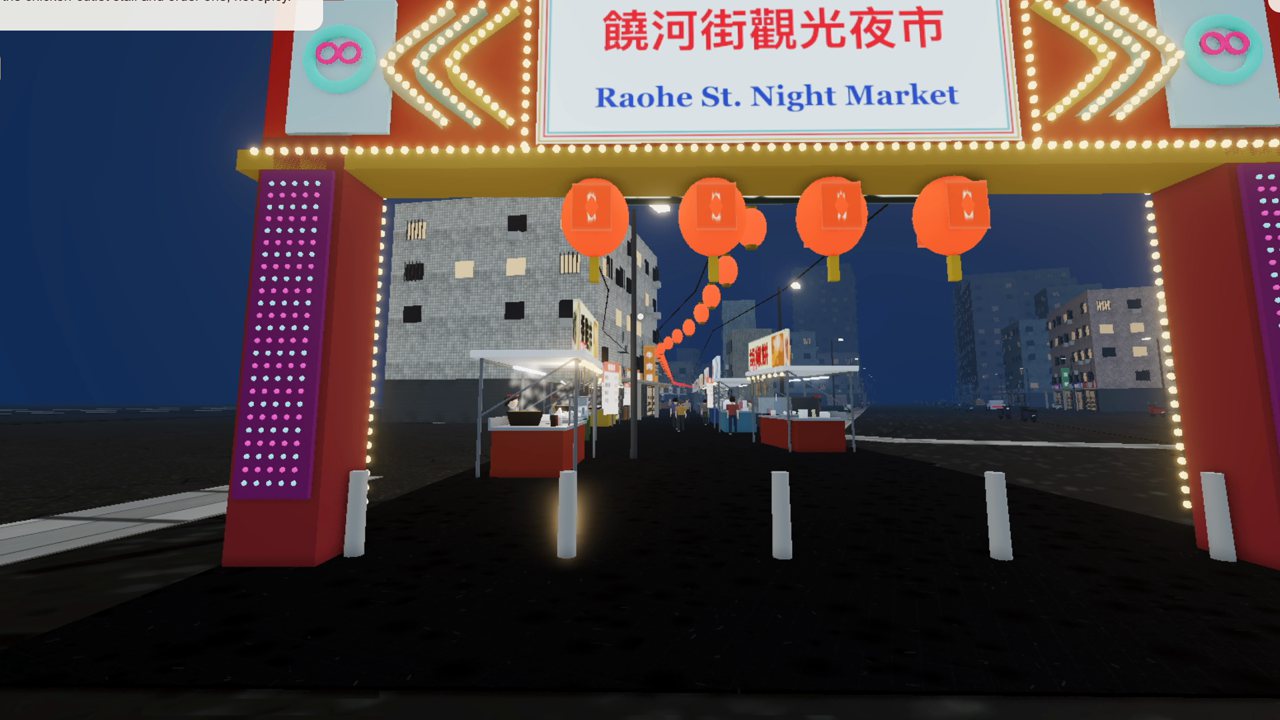
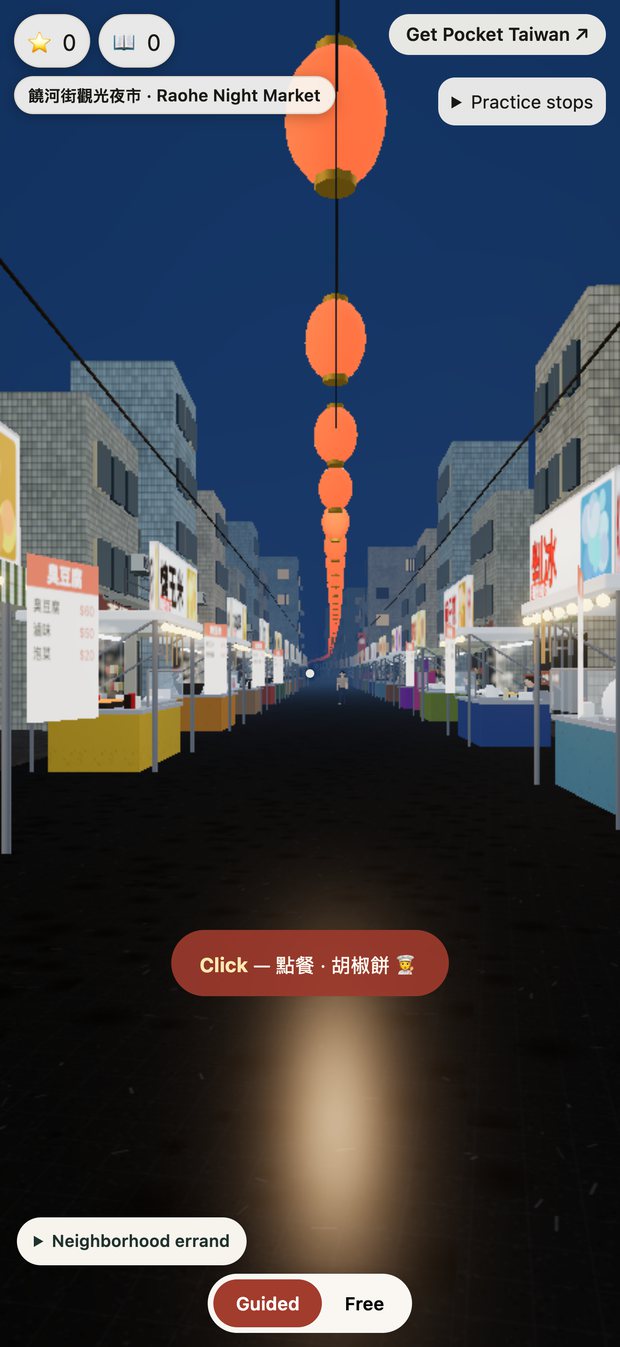
Raohe Street, rebuilt as a place you can walk through. Every stall has a boss who only speaks Mandarin. Order, handle the follow-up question, pay — and tap anything you see to learn the word for it. Same phrases as the app, now in the place you'd use them.
Stinky tofu, pepper buns, bubble tea, shaved ice — a hundred stalls along the real Raohe Street layout, each with its own menu to practice from.
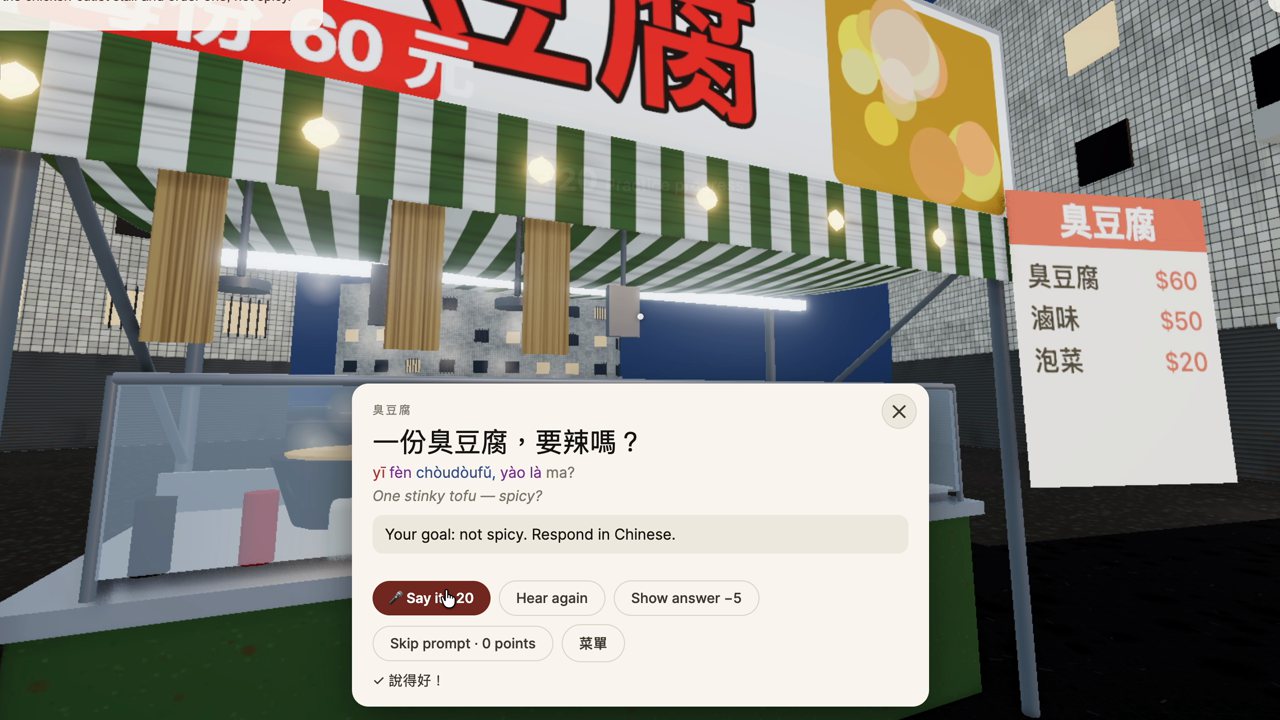
Say 我要一份臭豆腐 and you'll hear 要辣嗎? — spicy? Answer that too. Guided mode gives you the goal in English; Free mode just lets you talk.
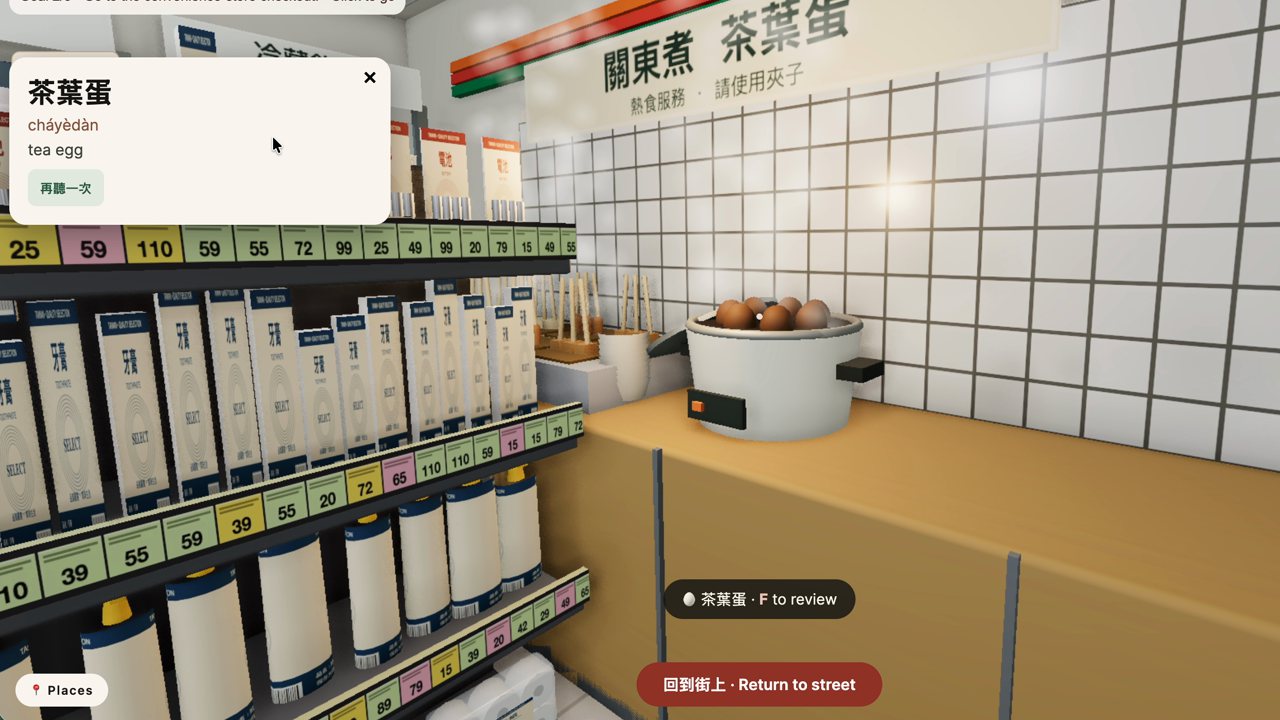
Signs, shelves, the tea-egg pot at the convenience store: tap it and get the characters, pinyin and meaning, with audio.
Use the microphone and the stall checks your Mandarin, or leave speaking off and answer by tapping while you build confidence.


Phone or computer, no download. Conversations need an internet connection. Experimental and free: the night market and five practice situations today, more on the way. On a phone, Safari or Chrome work best.
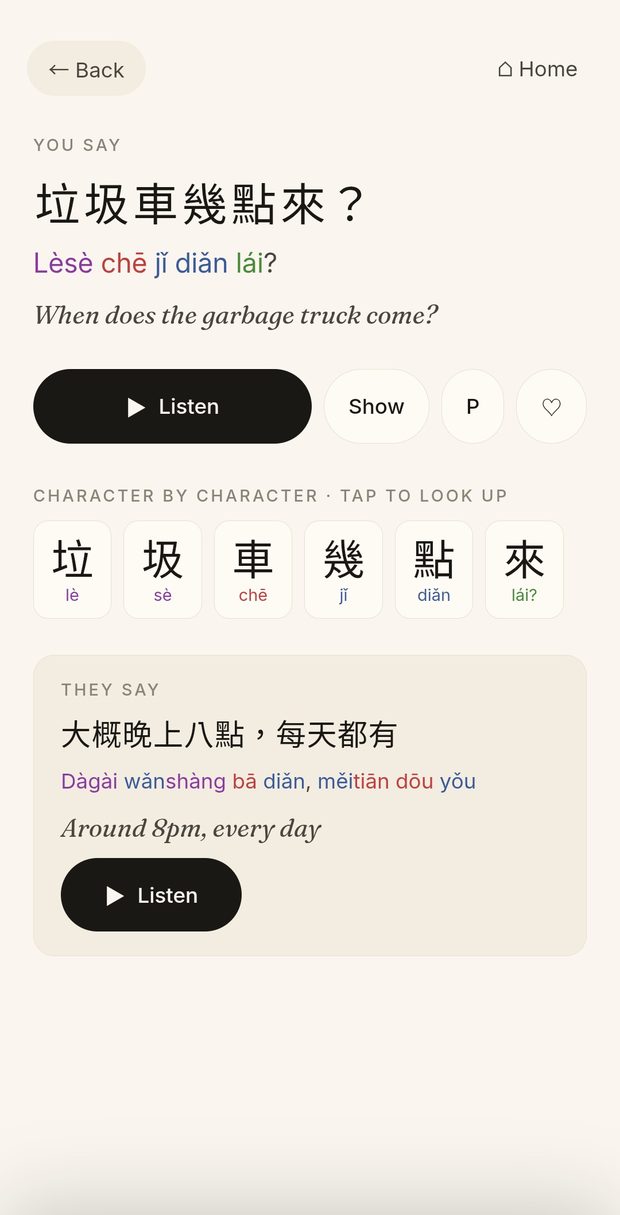
You learn your lines and they land. Then comes the follow-up you didn't rehearse. Each situation gives you both sides — what to say, and what comes back — so the whole exchange is familiar before you're standing in it.
Open the one you're about to walk into. Each has the phrases you'd say, the replies you'll hear, and a note on how the situation actually works here.
…and two dozen more, from breakfast shops and haircuts to phone calls, deliveries, and apologizing properly.
No lessons to unlock, no streak to maintain. Open the situation, find the phrase, tap to hear it.

Browse by situation. Grouped the way life is — food, errands, health, transit, officialdom.

Taiwan notes. How the situation actually works here, not just the words for it.
AI practice mode. The app plays the clerk; you reply, in Chinese or English.

Pocket Taiwan World. Say a saved phrase at a stall and it counts toward your review.
Traditional characters, Taiwan tone readings, and local vocabulary. Not Mainland Chinese with a flag swapped in.
Audio on every phrase, with tone-colored pinyin so you can see the shape of the word while you hear it.
The AI plays the clerk, the server, the landlord. Rehearse the whole conversation before you're standing in it.
The context nobody teaches: how the trash truck works, what 載具 is for, why the pharmacy asks for your 健保卡.
Tap ♡ on a phrase and it joins your reviews. They come back on a spaced schedule — minutes at first, then days, then months — so the ones you keep forgetting come round more often.
Loads once and keeps working — basement noodle shops and MRT platforms included. No account, no tracking.
Mainland-focused courses will get you understood in Taiwan — and mark you as someone who learned elsewhere. These are the words people here actually use.
| In English | Taiwan says | Your course taught |
|---|---|---|
| Scooter | 機車 jīchē | 摩托車 mótuōchē |
| Metro | 捷運 jiéyùn | 地鐵 dìtiě |
| Taxi | 計程車 jìchéngchē | 出租車 chūzūchē |
| Garbage | 垃圾 lèsè | 垃圾 lājī |
| Lunchbox | 便當 biàndāng | 盒飯 héfàn |
No subscription, no trial countdown, no account to create.
Roughly US$4.99 — Google Play shows the price in your own currency. Android for now — iPhone waitlist here.
“I'd lived in Taipei for years and could order coffee without thinking. But when I wanted the server to help me clear the table, I had no idea the keyword to get that to happen was 收 — a sentence like 可以幫我收走嗎?”
Written from living here — free to read, no app required.
Characters, tones, and the everyday vocabulary that Mainland courses get wrong for Taiwan.
The short list daily life here actually runs on, with Taiwan pronunciation.
Schools, self-study, scholarships, visas, and a realistic path.
Duolingo, Pleco, Glossika and the rest — judged by whether they work for Taiwan.
Both, for different reasons. Beginners get the exact sentences they need with audio and pinyin. People who already speak some Mandarin tend to use it for the situations they've been avoiding — the clinic, the bank, the landlord — where the vocabulary is narrow but unfamiliar, as well as certain phrases they simply never knew in more familiar situations.
Translate is for when you're already stuck: phone out, mid-conversation. This is for before and during — so you walk in already knowing the handful of things you'll need, and can find the right line mid-conversation without typing anything. Translate also tends to give Mainland vocabulary and won't know what 載具 means in context. Honestly, they pair well: prepare with this, keep Translate for curveballs.
Traditional, throughout — that's what Taiwan uses. Pronunciations follow Taiwan standards too, so 垃圾 is lèsè, not lājī.
Raohe Night Market as a place you can walk through, built from the real street layout. Stalls have bosses who only speak Mandarin: you order, they ask the follow-up, you answer, you pay. Tap anything you see for its characters, pinyin and meaning. It plays in your browser on a phone or computer, and inside the Android app, where a phrase you say at a stall counts toward your review. It's free and experimental — expect rough edges, and tell me what to build next.
It's being built now and is close. In the meantime the free tier works in any phone browser: open it in Safari, add it to your home screen, and it behaves much like an app, offline included. Pocket Taiwan World plays in Safari today. The paid unlock is currently Android-only.
Leave your email and you'll get one message the day the iPhone version is ready. Nothing else, ever.
Used only to send that one email. Not shared, not added to any list.
No account, ever. Once loaded it works offline — everything stays on your device. Only the AI practice mode needs a connection, and it sends just what you type.
Pick a situation and it plays the other person — the server, the clerk, the landlord — while you reply in Chinese or English. You can also have it show a full sample conversation first. It's rehearsal for the real thing, with pinyin and audio throughout.
Yes. Tap ♡ on any phrase and it joins your reviews. They come back on a spaced schedule — minutes at first, then days, then months — and the ones you keep forgetting come round more often. You can be shown the English and recall the Chinese, or flip it the other way. Review works on the free situations too, not just the paid ones.
On your phone, in the app itself — there's no account and nothing is uploaded. They survive app updates and reinstalls. Getting a new phone is the one case they don't follow you automatically, so Settings has "Back up my data", which saves everything to a file you can load on the new device.
Five situations free, and a night market to practice them in. See if it helps before you pay anything.